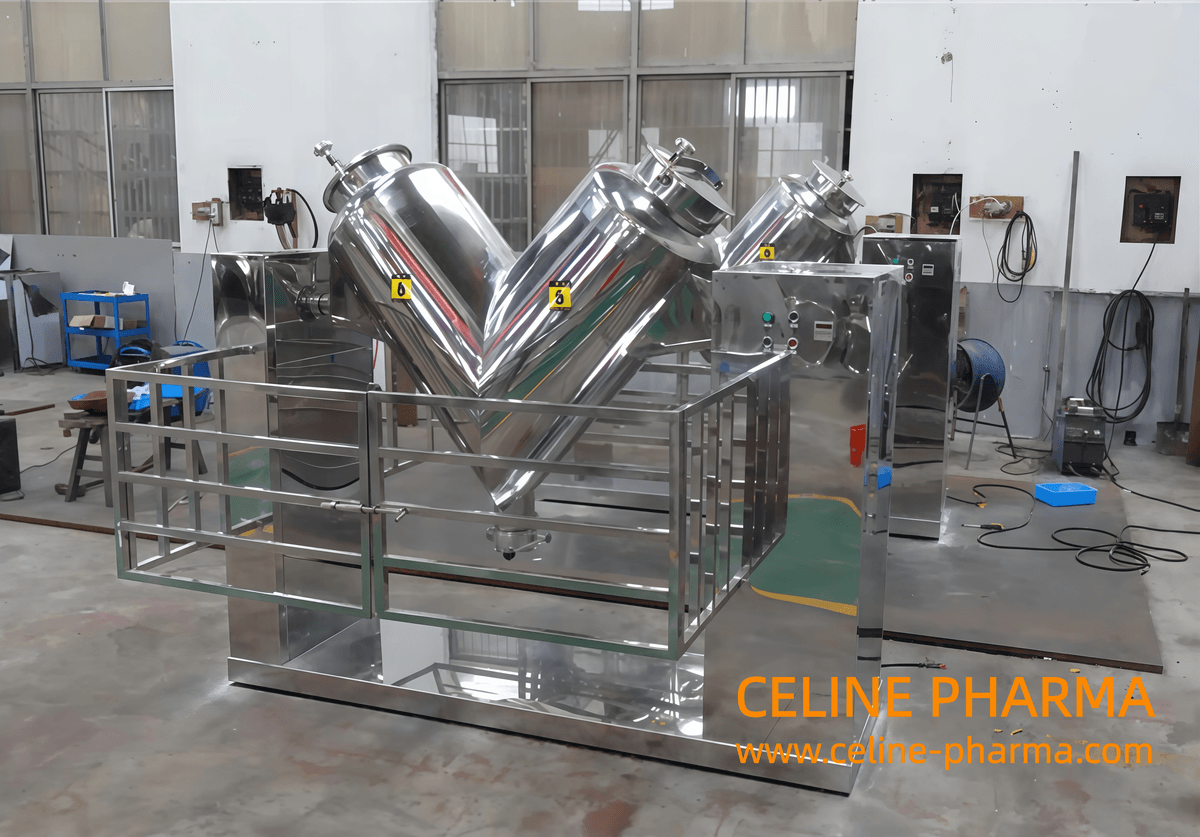

Analysis of Uneven Material Mixing in V-Type Blender
V-type mixers primarily use convection mixing. Uneven mixing is often related to the feed rate, material characteristics, operating parameters, and equipment structure. The solution is to first perform a simple troubleshooting step, then adjust parameters, and finally modify the structure/process.
I. Quick Solutions
1. Inappropriate Feed Rate (Common Cause)
- Problem: V-type mixer filling rate 30%~50%
- Fill rate > 60%: Insufficient space for material to be thrown within the drum, convection is obstructed, resulting in uneven mixing;
- Fill rate < 20%: Too little material, low probability of collision mixing, and easy agglomeration.
- Solution: Strictly control the feed rate within the **30%–50%** volume range.
2. Material Feeding Sequence/Inadequate Premixing
Problem:
Direct addition of trace components (additives, masterbatches, pharmaceutical powders) easily leads to agglomeration and uneven distribution; separation of light and heavy powders, and coarse and fine powders.
Solutions:
- Trace components should be premixed with a small amount of the main material (dilution method) before being added to the main mixing unit;
- Add the larger amount of the main material first, then the smaller amount of the component;
- Materials prone to agglomeration should be sieved/crushed to deagglomerate before mixing.
3. Insufficient/Excessive Mixing Time
Problems:
- Too short time: Uniform convection and diffusion are not completed;
- Too long time: Backmixing (segregation) occurs, and coarse/fine/light/heavy materials separate again.
Solution:
Perform gradient tests according to the material. For conventional powders, mixing time is mostly 5–20 minutes.
4. Significant Differences in Material Properties
Problems:
Significant differences in particle size, density, flowability, and moisture content easily lead to segregation and stratification.
Solution:
- Adjust the particle size distribution of the material to reduce particle size differences;
- Control the moisture content of the material within an appropriate range to avoid agglomeration;
- For viscous materials, a small amount of flow aid can be added to improve flowability.
II. Equipment Operating Parameter Adjustment
1. Spindle Speed Mismatch
V-type mixers have a critical speed; the commonly used operating speed is 30%–50% of the critical speed.
- Too low speed: Insufficient material lifting height, weak mixing;
- Too high speed: Material is stuck to the wall by centrifugal force, failing to fall and convect.
Solution:
For frequency converter models, adjust the speed; generally 10–30 r/min is the common range, ensuring the material can be lifted to the V-angle and fall.
2. Equipment Not Level / Cylinder Abnormality
Problem:
The equipment is installed at an angle, causing material to deviate to one side, resulting in an unbalanced circulation path.
Solution:
Level the equipment and tighten the anchor bolts; check the V-shaped cylinder for deformation and for protruding material adhering to internal welds.
3. Internal Material Accumulation and Wall Adhesion
Problem:
Old material remains on the cylinder wall and in dead corners, contaminating/unevenly mixing new material.
Solutions:
Stop the machine and clean the inner wall and dead corners of the discharge port; polish the inner wall to reduce adhesion; apply an anti-stick coating to sticky materials.
III. Equipment Enhancement and Modification (for difficult-to-mix materials)
1. Add a forced stirring paddle (flying knife device)
Applicable to: Materials that easily agglomerate, are fibrous, or have large specific gravity differences. Function: Breaks up clumps, forces dispersion, compensates for the shortcomings of V-type mixers for difficult-to-mix materials, and significantly improves uniformity.
2. Add an inner baffle/guide plate
Applicable to: Powders with excessive flowability and easy segregation. Function: Disrupts the material circulation trajectory, enhances shearing and cross-mixing, and reduces stratification.
3. Optimize the discharge structure
- Add a guide plate to the bottom discharge port to prevent segregation of coarse and fine materials during discharge;
- Use multiple discharge mixing processes to improve final uniformity.