

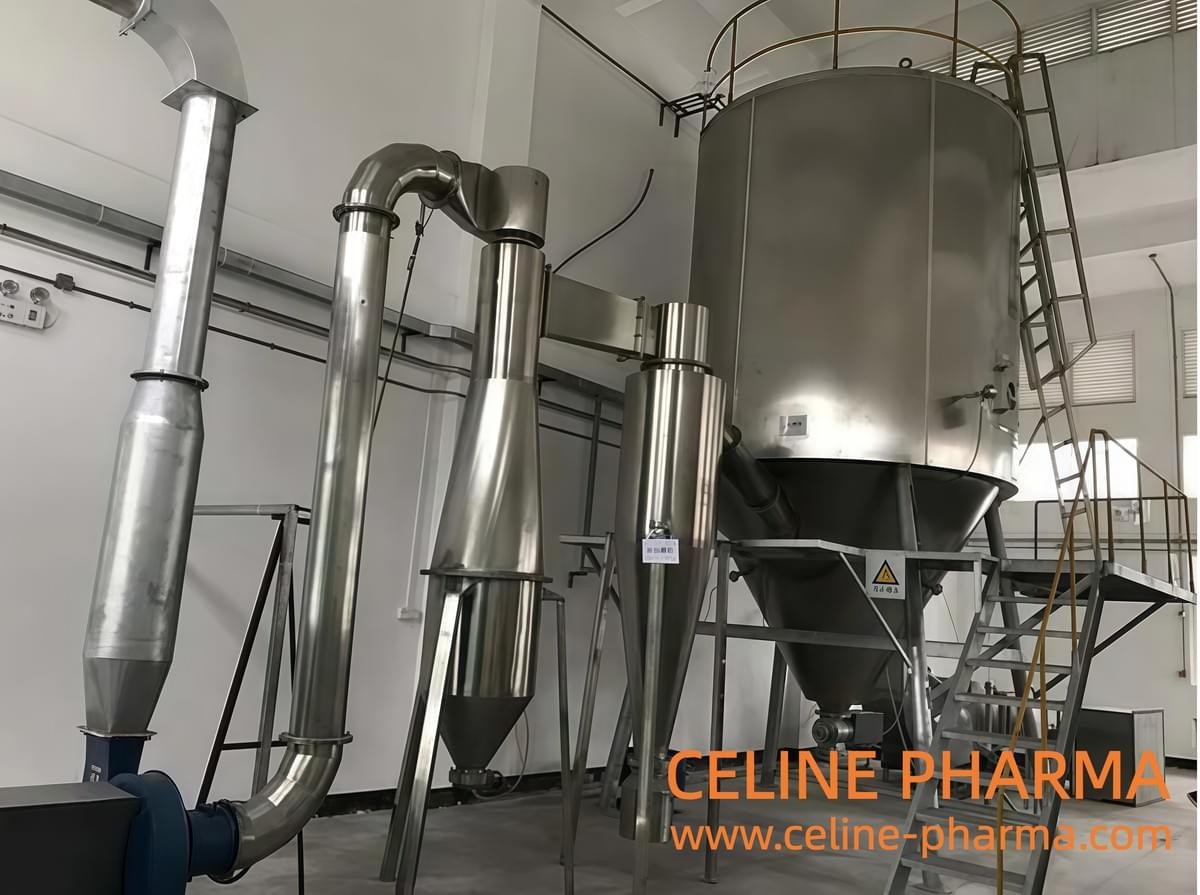
Centrifugal spray dryers are currently one of the most popular drying equipment in the industry. They are specialized drying equipment suitable for drying liquids such as emulsions, suspensions, pastes, and solutions. High-speed centrifugal spray dryers have a wide range of applications. They can be considered drying machines for processing solutions, suspensions, or slurry-like materials. Centrifugal spray dryers offer excellent drying results and high efficiency, producing uniform granular powder without the need for additional grinding processes. Currently, spray dryers are widely used in the chemical, light industry, and food industries.
They perform particularly well in the drying of liquid materials such as polymers and resins; dyes and pigments; ceramics and glass; rust removers and pesticides; carbohydrates and dairy products; detergents and surfactants; fertilizers; and organic and inorganic compounds. High-speed centrifugal spray dryers complete the drying process in a short time, making them suitable for drying heat-sensitive materials while maintaining the material's color, aroma, and taste. The production process is simplified, operation and control are convenient, and it is suitable for continuous production. Hot air enters the dryer uniformly in a spiral pattern. The liquid material is pumped from the liquid tank through a filter to the centrifugal atomizer at the top of the spray dryer, where it is sprayed into extremely small droplets. The liquid material and hot air come into contact in a co-current flow, and the moisture evaporates rapidly, drying into the finished product in a very short time. The finished product is discharged from the bottom of the spray dryer and the cyclone separator, and the exhaust gas is extracted and discharged by a fan.
Regarding energy consumption, by observing the production process, we can easily identify the problems. Solving and optimizing from the source is the key to fundamentally addressing the issue. For example, using a heat exchanger to bring the high-temperature exhaust gas into contact with the low-temperature incoming air can increase the temperature of the incoming air. This fully utilizes the heat in the exhaust gas, thereby reducing the amount of heat transfer oil used and lowering production costs. This is one of the feasible methods. Below are three common methods for energy saving and consumption reduction in centrifugal spray dryers.
1. Increasing the Inlet Temperature of the Hot Air
Under the condition of constant outlet temperature, the higher the inlet temperature of the hot air (also known as the incoming air temperature), the greater the total heat introduced, the more heat is transferred from the hot air to the slurry droplets per unit mass, and the more water is evaporated by the hot air per unit volume. With a constant production capacity, the required hot air volume decreases (i.e., the heat carried away by the hot air when leaving the tower is reduced), which lowers the heat consumption of the centrifugal spray dryer for powder production, and improves the utilization rate and thermal efficiency of the hot air. However, the inlet temperature of the hot air should not be too high (not exceeding 600°C), as excessively high temperatures will damage the air distributor at the top of the tower.
2. Lowering the Outlet Temperature of the Hot Air
With a constant inlet temperature of the hot air, the lower the outlet temperature of the hot air, the greater the temperature difference between the inlet and outlet, and the greater the thermal energy transferred from the hot air to the slurry for drying, thus resulting in higher hot air utilization. However, the exhaust air temperature should not be too low; below 75°C, the powder will be too wet, affecting normal drying.
3. Recycling of the Outlet Hot Air (Waste Gas)
After ceramic slurry is processed into powder by spray drying, if the outlet hot air is directly discharged into the atmosphere, the heat loss will be considerable (approximately 10% to 20% of the energy consumption of the powder production process). Therefore, this waste heat should be fully utilized. For example, the outlet hot air can be recycled to the preheating and drying process. In addition to direct recycling, this waste heat can also be stored or exchanged using a heat exchanger before reuse.